

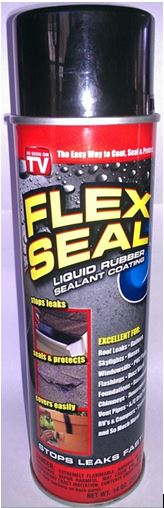
 Does Flex Seal really work on a leaking basement wall crack? After repairing thousands of foundations across New England, including plenty of walls where a homeowner tried Flex Seal first, our answer is no, not for this particular job. That is not a knock on the product in general. It is a rubberized spray coating built for the kind of surface leaks you see on a gutter, a roof flashing, or an RV seam. A basement wall crack is a different problem entirely, and the difference is exactly why so many of these repairs fail.
We do foundation crack repair in Boston and throughout Massachusetts, Rhode Island, New Hampshire, and Connecticut, and Flex Seal is one of the products we get asked about the most.
What Flex Seal Claims to Do
We picked up a can of Flex Seal from a homeowner who had already tried it and called us afterward. The label calls it a "rubberized leak sealer" for use on "foundations, basements, chimneys, and downspouts" and claims it "STOPS LEAKS FAST." Those claims are not wrong for the surfaces Flex Seal was actually designed for. The problem is that a basement wall crack does not behave like a gutter seam or a chimney flashing, and the label does not make that distinction.
Why Flex Seal Doesn't Stop Real Basement Leaks
A basement wall crack is not a surface problem. Water outside your foundation builds up hydrostatic pressure, especially after heavy rain or snowmelt, and that pressure pushes moisture through the concrete itself, not just through the visible gap of the crack. Flex Seal is applied to the inside surface of the wall, which means it is fighting that pressure from the wrong side. It can bridge a hairline gap on top of the wall, but it cannot stop water that is already moving through the concrete around it. Once enough pressure builds behind the coating, the water finds the edge of the patch or a new path a few inches away, and the leak comes back.
What We've Seen When Homeowners Try It
We have repaired a good number of basement wall leaks, floor leaks, and leaks around pipe penetrations that started with a homeowner trying Flex Seal first. The pattern is almost always the same: it holds for a little while, sometimes through a dry stretch of weather, and then fails the next time it rains hard or the ground freezes and thaws. We have documented this often enough that it is not really a question of if it will fail, just when.
Two examples from our own case files show how this usually plays out. In one Nashua, New Hampshire home, a leaking tie rod got the hydraulic cement treatment first, then Flex Seal, and both failed the next time it rained before the real fix, a closed-cell polymer resin injection, solved it for good. In another basement wall crack we looked at, the same pattern showed up again after a freeze-thaw cycle.
Flex Seal’s Uses and Limitations on Basement Walls
To be fair to the product, Flex Seal is not useless everywhere. It can work reasonably well on the surfaces it was actually built for: gutters, flashing, RV and trailer seams, and small gaps above grade where there is no real water pressure pushing against it. Does Flex Seal work on concrete in general? For a dry, above-grade surface with a minor cosmetic gap, a coating like this can buy you some time. The issue is specifically foundation and basement walls below or near grade, where hydrostatic pressure is part of the equation and a surface coating was never built to handle it.
What Actually Stops a Leaking Foundation Crack
The fix that actually holds up against hydrostatic pressure has to work from inside the crack itself, not just across the surface of it. For most active basement wall cracks, that means a polyurethane foam injection or an epoxy injection crack repair, depending on whether the crack is still moving or already stable. Polyurethane foam expands to fill the full depth of the crack and stays flexible as the concrete moves slightly with the seasons, which makes it a good fit for a crack that is still leaking or likely to keep shifting. Epoxy is rigid once it cures, so we use it when the goal is to structurally bond a stable crack back together rather than just seal it. For cracks around tie rods or other pipe penetrations, we use a closed-cell polymer resin that encapsulates the metal from the inside. We also use carbon fiber staples and woven carbon fiber blankets on walls that need reinforcement, not just a seal.
Good Flex Seal Alternatives
If you are looking at Flex Seal alternatives because you already know a spray coating is not going to cut it, the honest options split into two categories. For a genuinely minor, above-grade, cosmetic gap, a proper concrete patching compound or hydraulic cement can outperform a rubberized spray, though hydraulic cement has its own limits once the concrete starts expanding and contracting again. For an actual basement wall crack below grade, the real alternative is not a different product off the shelf; it is a proper injection repair done from inside the crack, which is the only approach that addresses the water pressure directly instead of trying to block it from the surface.
If Flex Seal Hasn’t Stopped the Leak, We Can Help
If you’re wondering, "Does Flex Seal really work?” it can seal some small gaps, but it may not fix a basement leak when water pressure behind the wall is a factor. If the leak has returned, call A-1 Foundation Crack Repair at 866-929-3171 or contact us online for a free phone consultation. We’ll explain whether crack injection or another repair may suit your situation.