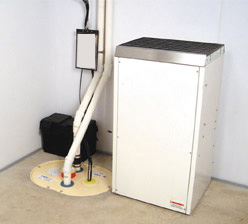
 Basement dehumidifier installation is designed for homes with persistent dampness, condensation, or high humidity that cannot be fully resolved by waterproofing alone. A professionally installed basement or crawl space dehumidifier helps control moisture levels, protect indoor air quality, and reduce the risk of mold and musty odors, keeping your home healthier and more comfortable year-round.
Basement and crawl space dehumidifier installation is commonly recommended for homes experiencing:
If moisture remains present without visible leaks, a dehumidifier is often the correct solution.
Even when there are no visible foundation leaks, moisture can still enter a basement through concrete walls and floors. Concrete naturally absorbs moisture from the surrounding soil and releases it into the basement through capillary action, increasing humidity levels and creating a damp environment.
Moisture can also enter as water vapor, slowly passing through concrete and raising indoor humidity over time.
Basement waterproofing systems are designed to stop liquid water intrusion, but they do not remove moisture already present in the air. A basement can be fully waterproofed and still feel damp if humidity levels remain high.
Without active humidity control, moisture can continue to collect on cool surfaces, leading to discomfort, odors, and potential mold growth.
During warm, humid weather, outside air entering the basement cools rapidly. As the air cools, its relative humidity increases, often reaching the point where excess moisture condenses on cool surfaces such as basement floors, walls, pipes, and equipment.
This condensation is a common cause of damp basements during summer months and is best controlled through proper dehumidification.
Proper basement dehumidifier installation ensures the system operates efficiently and performs as intended over time. Professional installation helps prevent common issues such as undersized equipment, improper drainage, and ineffective humidity control.
Benefits of professional installation include:
| Specifications | |
| Airflow - CFM | 275 CFM |
| Capacity (Pints removed per day) | 100 |
| Area Covered | 2500sqft |
| Noise Level | 58-62dBA |
| Condensate Pump | Optional |
| Humidistat | Built-in |
| Defrost | Built-in |
| Watts | 760 |
| Pints/kWh | 5.6 |
| Voltage | 115 |
| Amps | 6.8 |
| Lowest Operating Temp | 55°F |
| Energy Star Rated | Yes |
| Ducted | Yes |
| Drain Hose | 8-foot |
| Portability | Casters |
| Filter | Merv 11 |
| Dimensions (H x W x D) | 36" x 20" x 17" |
| Weight | 110 lbs |
Waterproofing stops liquid water from entering through walls and floors, while a dehumidifier removes moisture already present in the air. A basement can be fully waterproofed and still feel damp, which is when dehumidification is needed.
Usually not well. Basements and crawl spaces need equipment sized for the square footage and conditions, with proper drainage and a calibrated humidistat. An undersized or portable unit often cannot keep up with the moisture load.
A basement is generally kept between 30 and 50 percent relative humidity. Staying in that range limits condensation, musty odors, and the conditions that support mold, while keeping the space comfortable.
Most fixed installations drain continuously through a hose to a sump, floor drain, or pump, so there is no reservoir to empty by hand. Proper drainage is part of a professional installation.
A dehumidifier benefits from periodic filter cleaning and a check of the drain line and humidistat. Routine attention keeps it running efficiently and extends the life of the unit.
A-1 Foundation Crack Repair has helped homeowners across Massachusetts, New Hampshire, Rhode Island, and Connecticut control basement moisture since 1993. If your basement stays damp despite waterproofing, a professionally installed dehumidifier may be the missing piece. Contact A-1 to speak with a live professional or to request a free estimate.
A-1 Foundation Crack Repair, Inc. is a fully registered home improvement contractor. Contact us today to talk to a knowledgeable, master waterproofing professional.
E-mail: info@a1foundationcrackrepair.com
Toll Free: 866-929-3171
Call Us Today at 866-929-3171
A-1 Foundation Crack Repair, Inc. is a fully registered home improvement contractor. Contact us today to talk to a knowledgeable, master waterproofing professional.